
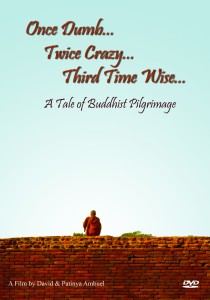
 Once Dumb, Twice Crazy, Third Time Wise:
A Tale of Buddhist Pilgrimage

A film by David & Patinya Ambuel
(2011, 94 minutes, English and Thai with English subtitles)

This documentary follows a group of Thai Buddhists, made up of monks and lay followers, as they embark on a pilgrimage to the sites of Buddhism’s roots in India and Nepal. The film illuminates basic Buddhist principles by observing these pilgrims’ practices and examining their goals and aspirations in undertaking this journey to retrace the Buddha’s life from his birthplace in Lumbini, to the place of enlightenment at Bodhgaya, his first teaching at Sarnath, and his death at Kushinagar.
Once Dumb, Twice Crazy, Third Time Wise provides a rich introduction to Buddhist principles and basic teachings, while taking the viewer to the significant historical sites of Buddhism in India and Nepal as they are today and giving the viewer a glimpse into the Theravada Buddhist practices of Thailand.
Each year thousands of Thai Buddhists undertake the pilgrimage to India, seeking to retrace the footsteps of the Buddha by traveling to worship and make offerings at the four traditional primary Buddhist pilgrimage sites, each of which marks an important event in the Buddha’s life. These are the places of the Buddha’s birth, enlightenment, first teaching, and death.
The Thai monks are fond of saying that the first time pilgrim is simply dumb, the repeat pilgrim, who undertakes a second journey after the rigors of the first, is crazy, but, with the third journey, the pilgrim attains wisdom. Once Dumb, Twice Crazy, Third Time Wise follows one such group of pilgrims from Thailand, about half ordained monks and half lay followers, many on their first pilgrimage and first trip outside their home country.
The film accompanies them to Lumbini, where Gautama Siddartha was born a prince in the 5th or 6th century B.C.E., to the Bodhi tree at Bodhgaya, the seat of the Buddha’s enlightenment, to Rajgir and the adjacent Vulture Peak, the traditional setting of many of the Buddha’s sermons, to the ruins at Nalanda, the vast ancient Buddhist university of the 5th century C.E., to Sarnath, where the Buddha began his teaching and received his first disciples, to Kushinagar, where his life ended with the Buddha’s parinirvana. At the conclusion of their journey, the pilgrims contemplate the Buddhist teachings on life and death as they watch traditional Hindu cremations along the banks of the Ganges.
In addition to these historical sites that are sought out by pilgrims of all Buddhist traditions, the pilgrims visit and spend their nights at Thai temples, of which many have been founded and are now flourishing in India, growing with the rise of modern pilgrimage to the lands of Buddhism’s origins, where indigenous Buddhism has long since vanished.
Interspersed throughout the documentary is a series of interview segments with Pra Maha Cheta Visuthisiri, a Thai monk who has spent years in India. Pra Cheta discusses basic Buddhist teachings, the principles and goals of pilgrimage, rituals practices, Buddhist ethics, meditation, and the question of suffering and death.
Once Dumb, Twice Crazy, Third Time Wise is an educational documentary that offers a superb introduction to Buddhism for the classroom and also sure to appeal to anyone interested in Buddhism, Asian history, and culture.